(Battle of Cambrai 20th November - 3rd December 1917)
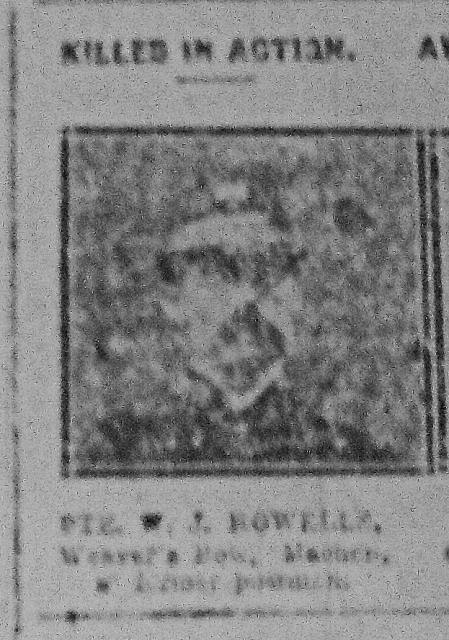
The Commonwealth War Graves record list (266782) as Private William John
Howells died aged 28 Son of William and Ellen Howells of Union Street,
Nantyffllon, Bridgend. In fact William John Howell (25033) and Walter
John Howells (266782 Machen) both serving with the 17th Battalion the
Welsh Regiment were killed in action on 25.11.1917. To date both recorded
as the son of William and Ellen Howell(s) of Nantyfflon.
Walter John Howells was the son of Walter and Rachael Howells of 1 Weavers
Row, Machen. One of his elder brothers also served in the Great War and
lost a leg as a result of wounds. Rachael Howells never believed that
her son had died and always left the door open, convinced he would return.
The 17th Battalion (1st Glamorgan – ‘Rhondda Bantams’)
Welsh Regiment was one of a number of battalions establish early in the
war made up of men who were below the ‘minimum height’ for
active service. Many Bantams were well below the 5’3” minimum
height and 34” chest requirement, although Bantam Battalions served
with distinction on every front during the Great War.
The battalion diary records that they ‘proceeded by night march
to Graincourt to assemble for the attack on Bourlon Wood’.
They were to attack with the assistance of tanks, the battalion moved
forward through Anneux to the south edge of the Cambrai Road.
The diary records that, early in the advance ‘A’ Company
became aware of a large party of the enemy on its right flank directing
fire against the Division operating on our right. The party was successfully
attacked and 50 prisoners taken.
The attack achieved many of its early objectives and by the actions
of the 23rd of November the Division held key positions in Bourlon Wood.
At dawn on the 24th the enemy delivered a very heavy counter attack
along the greater part of the front but mainly against the centre. In
the 'heavy fighting B and C companies lost their last remaining officers
and suffered heavy losses. The arrival of reinforcements stiffened the
defence and despite all the efforts of the enemy the whole of the high
ground in the woods remained in our hands, the 17th Welsh were still holding
out’.
Following their reinforcement a further advance was ordered from the
newly won positions, however this ‘made little or no progress
and the attack came to a standstill’. During the 24/5th
‘an immense amount of work was done organising leaderless men of
different units and sending them back to the firing line as fighting units
under recognised leaders. The promptness with which this was done and
the alacrity with which orders were obeyed alone rendered it possible
to stiffen the line of resistance at critical periods, and enabled our
troops to hold on to the all important high ground in the wood. The astonishing
valour and tenacity displayed by all units of the 119th Brigade in face
of extremely heavy shelling and continuous attacks enabled the 119th to
hold the important tactical position of Bourlon Wood'.
Message from General Sir Julian Byng, Commander Third Army
The capture of Bourlon Wood, to my mind stands out among all the
other splendid actions of our infantry since the attack started on the
20th; and in years to come I shall remember with unqualified satisfaction
that it was performed by the splendid Division that I have now been associated
with for some time.
A recent description of the Battle of Bourlon Wood (W. Moore 1988, A
Wood Called Bourlon) and the part played by the bantams suggests that,
If, before the war, anyone had told a stunted Gwent miner that one
day he might have to fight for his life against Pomeranian Grenadiers
he would have been declare mad, but the whole scenario would have been
unimaginable even in 1914. Bourlon resembled a steaming compost heap.
The account further describes the aerial combat going on over the battlefield
and how at 1.00 p.m. the ‘Red Baron’ Von Richthofen appeared
over the battle zone and forced his victim to crash land behind British
lines.
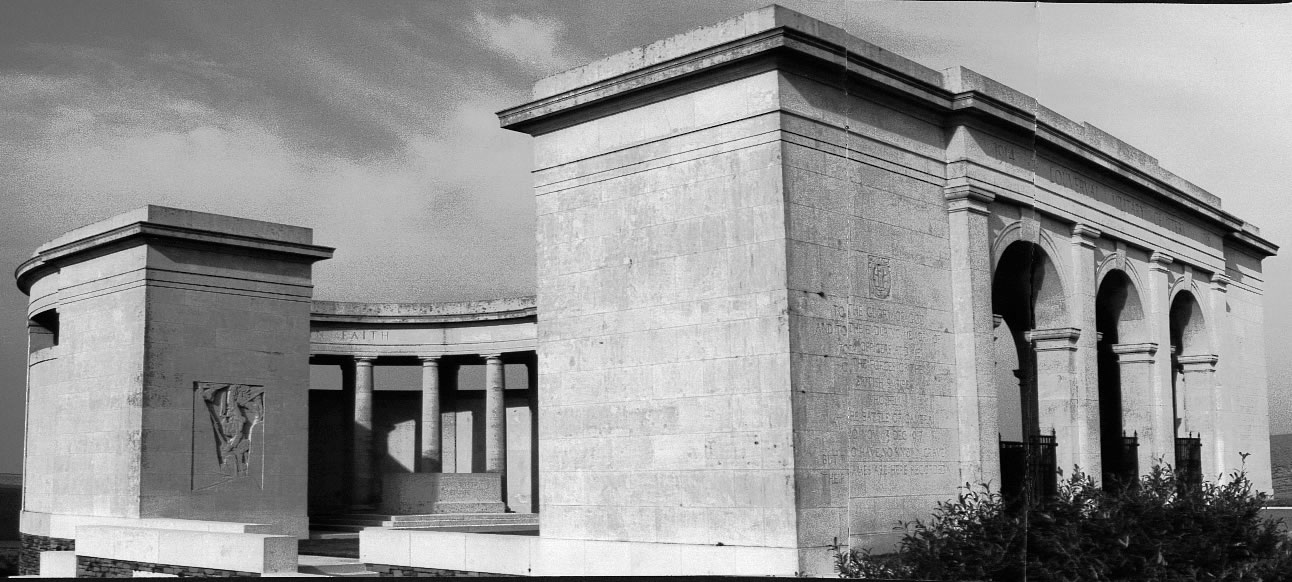
Private Howells has no known grave and is commemorated on a Battalion
Memorial in St Basils Parish Church, Bassaleg and the Cambrai
memorial, Lourerval, France. The memorial has the following inscription:
To the glory of God and to the enduring memory of 7048
officers and men of the forces of the British Empire who fell at the Battle
of Cambrai between the 20th November and the 3rd December 1917, whose
names are recorded but to whom the fortunes of war denied the known and
honoured burial given to their comrades in death.
Cambrai memorial where Walter John Howells is commemorated.
Return to Top
|